
When Should a Small Business Switch from Cash to Accrual Accounting?
If you’re running a small business, chances are you started with cash accounting—it’s simple, it works, and it keeps your books clean enough. But as your business grows, that simplicity can start to blur the bigger picture. This week’s blog breaks down when it’s time to level up to accrual accounting. We’ll walk you through the differences between cash and accrual (with a handy visual), show you the signs that it’s time to switch, and explain how accrual accounting can help you forecast better, impress investors, and stay audit-ready. Whether you’re scaling fast or just want more clarity in your numbers, this post is your roadmap.
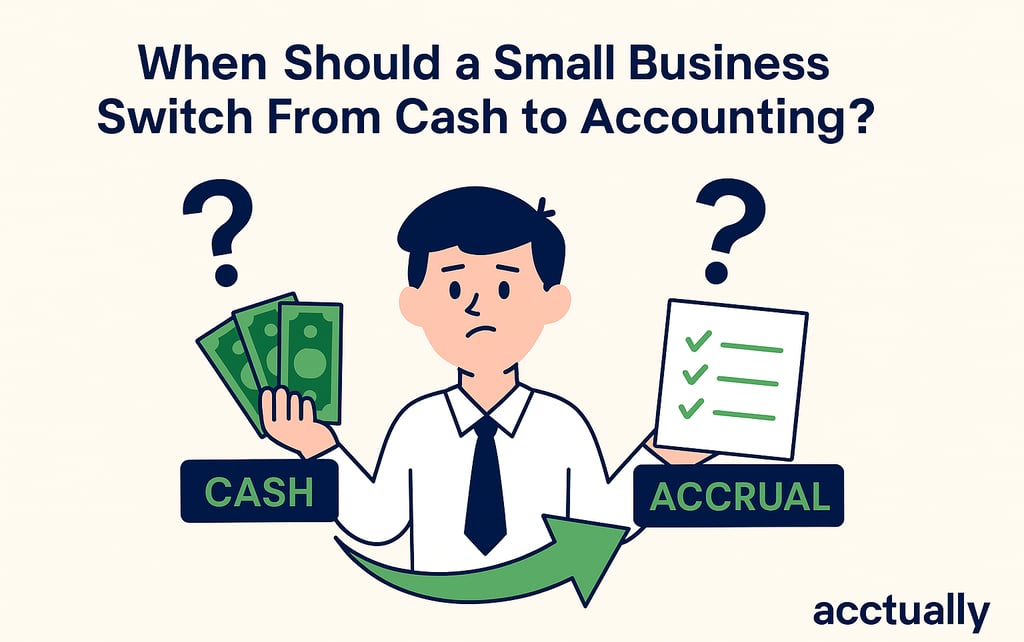
When Should a Small Business Switch From Cash to Accrual Accounting?
For many small business owners, cash accounting feels intuitive: you record income when money hits your bank account and expenses when you pay them. It’s simple, straightforward, and often sufficient in the early stages of growth. But as your business scales, this simplicity can become a limitation. That’s when accrual accounting enters the picture.
📖 Understanding Cash vs. Accrual Accounting
Cash Accounting
Records transactions only when money changes hands.
Easy to manage and ideal for very small businesses or sole proprietors.
Provides a snapshot of cash flow but not long-term obligations.
Accrual Accounting
Records income when earned and expenses when incurred, regardless of payment timing.
Aligns with Generally Accepted Accounting Principles (GAAP).
Offers a more accurate picture of profitability and financial position.
👉 Think of cash accounting as looking at your wallet today, while accrual accounting is looking at your entire financial roadmap.
🚀 Signs It’s Time to Switch
Revenue Growth Beyond $5M – IRS rules require accrual accounting once average annual gross receipts exceed $5 million.
Inventory Management – Carrying inventory generally requires accrual accounting to match costs with revenue.
Complex Contracts or Subscriptions – SaaS, long-term projects, or prepaid services benefit from accrual’s revenue recognition.
Seeking Financing or Investors – Banks and investors expect accrual-based financials.
Audit Readiness – Accrual aligns with GAAP, making audits smoother.
🌟 Benefits of Accrual Accounting
Accuracy: Reflects obligations, receivables, and deferred revenue for a true financial picture.
Strategic Insights: Reveals profitability trends and helps identify growth opportunities.
Forecasting Power: Improves cash flow planning by recognizing future inflows and outflows.
Credibility: Builds trust with lenders, investors, and auditors.
Scalability: Supports complex operations, multi-entity structures, and subscription models.
⚖️ Challenges to Consider
Complexity: Requires disciplined bookkeeping and stronger systems.
Cost: May involve hiring accountants or upgrading software.
Transition Effort: Converting historical records can be time-consuming.
✅ Practical Next Steps
Evaluate Your Growth Trajectory: If scaling quickly or eyeing funding, start planning the switch.
Consult a CPA: Transitioning involves technical adjustments, especially around revenue recognition and inventory.
Upgrade Your Systems: Cloud-based accounting platforms make accrual manageable even for lean teams.
📢 Call to Action
Switching from cash to accrual accounting isn’t just about compliance—it’s about clarity and growth. If your business is reaching new milestones, don’t let outdated reporting hold you back.
👉 At Acctually, we help small businesses make the transition smoothly, ensuring audit readiness, investor confidence, and smarter decision-making.
Ready to future-proof your financials? Contact us today to explore how accrual accounting can unlock your next stage of growth.
👉 Visit us at Acctually.com or reach out for a free consultation.
📧 Email us at hello@acctually.com
🌐 Visit us at https://acctually.com/
📞 Call us at (646) 543-4916